Back to Blog
Why Developers Should Learn Vibe Coding Without Skipping the Fundamentals
Vibe coding can help developers prototype faster, reduce repetitive work, and explore ideas more easily. But without strong engineering fundamentals, it can also help you create technical debt faster.
Back
Engineering
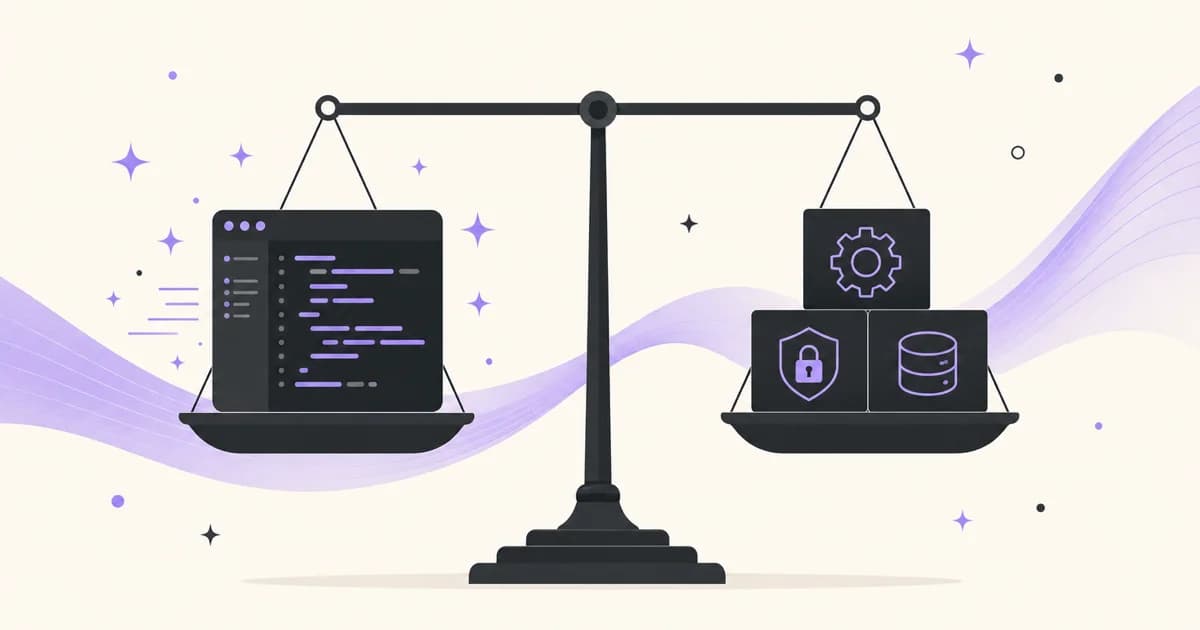
Table of contents
Vibe coding has become one of those terms that developers either love, hate, or make jokes about. Some people see it as the future of software development. Others think it is just lazy coding with AI. Personally, I think both sides are missing the point.
Here's the thing: vibe coding is not about blindly asking AI to build everything for you. It is about learning how to work with AI tools to move faster, explore ideas, and reduce repetitive work — while still using your engineering judgment. And that is exactly why developers should learn it.
If you are new to the term, start with what is vibe coding. If you already use AI in your workflow, this post is about why it is worth leaning in — and where the line is before you start shipping debt.
From Idea to Prototype, Faster
One of the hardest parts of building software is often not writing the code itself, but starting.
You have an idea, but then you need to set up the project, create the structure, write boilerplate, connect the API, prepare the UI, handle validation, and so on. With AI-assisted coding, you can skip a lot of the slow early steps.
For example, instead of spending one hour creating a basic CRUD module, you can ask AI to generate the first version, then review and improve it yourself. I have done this for landing pages, API stubs, and test scaffolding — the kind of work that used to eat a whole afternoon before I could even evaluate whether the idea was worth pursuing.
The important part is this: AI helps you get a draft faster, not a perfect system. That draft is your starting point, not your ship-it moment.
Experimentation Gets Cheaper
Before AI coding tools, trying a new library, framework, or architecture usually took more effort. Now, you can ask AI to create a small proof of concept, compare two approaches, or explain how a certain pattern might work in your project.
This is useful because developers often need to make decisions before writing production code:
- Should this feature use a queue?
- Should this module be separated?
- Should this API return this structure?
- Should I use a simple service class or introduce a more flexible pattern?
Vibe coding can help you explore those options faster. Real talk: I still use it heavily for prototyping and throwaway experiments, and keep core logic under stricter control — same split I wrote about in how vibe coding changed the way I work.
Repetitive Work Is Where AI Shines
A lot of development work is repetitive. Writing validation rules, creating DTOs, mapping API responses, generating test cases, preparing documentation, or converting raw SQL into a cleaner query builder format.
These tasks still require accuracy, but they do not always require deep creative thinking. This is where AI is very helpful.
A good developer should not waste too much energy on repetitive work if a tool can help. But the developer still needs to review the result. That review process is where real engineering skill matters.
It Forces You to Explain Problems Clearly
One underrated benefit of vibe coding is that it trains you to describe problems clearly. If your prompt is vague, the output will usually be vague too.
To get better results, you need to explain:
- what you are trying to build
- what constraints you have
- what stack you use
- what pattern you prefer
- what should be avoided
- what kind of output you expect
That is basically software communication — and communication is already a big part of being a good engineer. The better you get at framing a problem, the better your AI output and your code reviews with humans.
Vibe Coding Without Fundamentals Is Dangerous
This is the part that people often ignore.
If you do not understand the code generated by AI, you are not coding faster. You are just creating technical debt faster. AI can generate code that looks clean but has hidden problems:
- It may miss edge cases.
- It may create insecure logic.
- It may use the wrong abstraction.
- It may over-engineer a simple feature.
- It may generate code that works today but becomes painful to maintain later.
This is why fundamentals still matter. You still need to understand databases, HTTP, authentication, security, performance, architecture, testing, and debugging. AI can help you write code, but it cannot take responsibility for your system.
The Real Skill Is Reviewing, Not Prompting
Many people think the main skill in AI-assisted coding is writing prompts. Prompting matters, but reviewing matters more.
A strong developer can look at AI-generated code and quickly ask:
- Is this logic correct?
- Is this secure?
- Is this maintainable?
- Is this too complex?
- Does this match the existing codebase?
- Will this break in production?
- Is there a simpler way?
That is the difference between using AI as a tool and being controlled by AI output. I have seen teams ship broken auth flows and N+1 queries because nobody read the generated code — only the green checkmark in the browser.
Engineering Taste Still Wins
Good software is not only about working code. It is also about structure, naming, readability, trade-offs, and long-term maintenance.
AI can generate a solution, but it does not always know the context of your team, your project history, your business rules, or your production constraints. That is where engineering taste comes in.
A developer with good judgment can use AI to move faster without making the codebase messy. Pick one tool, learn its limits, and build repeatable patterns — that is how you move from simply prompting AI to actually engineering with AI. For tool choice and a 30-day plan, see master one AI coding tool first.
Bottom Line
Developers should learn vibe coding because it is becoming a practical part of modern software development.
Not because AI will replace all developers. Not because prompts are more important than programming. Not because we should trust every generated answer.
But because AI can help us work faster when we know how to guide it, review it, and correct it.
The future is probably not "AI replacing developers." It is developers who know how to use AI becoming much faster than developers who refuse to adapt.
So yes, learn vibe coding. But do not skip the fundamentals.
For more on the topic:
- What is vibe coding? — Definition, examples, and when it makes sense
- How vibe coding changed the way I work — Personal workflow and the prototyping vs core logic split
- Vibe coding experiment: building a coffee shop landing page with Antigravity — Hands-on from idea to HTML in under a minute
Frequently Asked Questions
Should every developer learn vibe coding?
Yes, in the sense of learning how to work with AI tools — not in the sense of outsourcing judgment. The skill is guiding, reviewing, and correcting output, not accepting whatever the model returns.
Is vibe coding the same as not learning to code?
No. Vibe coding assumes you can read, debug, and improve code. Without fundamentals, you cannot tell good output from dangerous output.
What is the biggest risk of vibe coding?
Shipping code you do not understand. That turns small wins (faster boilerplate, faster prototypes) into large losses (security holes, unmaintainable abstractions, production incidents).
Is prompting or reviewing more important?
Reviewing. Clear prompts help, but the engineer who can evaluate correctness, security, and fit with the codebase is the one who ships safely.
When should I avoid relying on AI-generated code?
For auth, payments, data integrity, security-sensitive paths, and core business logic in legacy systems — unless you review it as carefully as code you wrote yourself. Same bar, not a lower one.
References
- What is vibe coding? - Google Cloud - Overview of AI-assisted development and common use cases
- Vibe Coding - IBM Think Topics - Definition, benefits, and risks in enterprise context
- Vibe coding - Wikipedia - General background on the term and its usage
Comments
No comments yet
Loading comments...