Back to Blog
Claude Sonnet 5 Might Be the Most Important AI Release for Developers This Year
Claude Sonnet 5 may not be the biggest AI release of the year, but its balance of coding performance, pricing, and agentic capabilities could make it one of the most important for developers.
Back
Engineering
Table of contents
Every few months, a new AI model arrives with bigger benchmark numbers, longer context windows, and louder claims about reasoning. The cycle has become familiar.
But after reading through the Claude Sonnet 5 announcement, I think the interesting story is not about benchmarks.
The interesting story is economics.
Claude Sonnet 5 might quietly become the default AI model for many developers — not because it is the smartest model available, but because Anthropic is clearly positioning it as a high-capability model at a significantly lower cost than Opus-class models.
Anthropic describes Sonnet 5 as approaching Opus 4.8 on several important agentic evaluations — coding, tool use, reasoning, and knowledge work — while offering intro pricing of $2 per million input tokens and $10 per million output tokens through August 31, 2026. Standard pricing after that is $3/$15 per million tokens, compared with $5/$25 for Opus 4.8.
AI model pricing changes quickly these days, so if you are reading this months from now, check the latest rates in Anthropic's official pricing documentation.
For many teams, that is not a small difference. It is a purchasing decision.
Quick Answer
Use Claude Sonnet 5 if you want a model that can handle multi-step agentic coding work — plans, terminals, browsers, sustained follow-through across messy technical tasks — without paying flagship Opus prices for every workflow.
Skip the hype framing. Sonnet 5 is not trying to win every benchmark. It is trying to make serious agentic development affordable enough to run every day.
If you are still choosing between AI tools at a workflow level, start with Gemini vs ChatGPT vs Claude for Coding. This post is about why Sonnet 5 specifically matters in that landscape.
The Most Interesting Part Is Not Intelligence
For the past two years, AI releases have mostly followed the same pattern:
- flagship models push intelligence forward
- smaller models focus on speed and price
- developers choose between capability and cost
Anthropic seems to be trying something different with Sonnet 5.
The model is built to sit directly in the middle: powerful enough for serious coding work, cheap enough to use heavily every day. Anthropic describes it as the most agentic Sonnet model yet — able to make plans, use tools like browsers and terminals, and run autonomously at a level that, just a few months ago, required larger and more expensive models.
If that strategy works, it could end up being more important than simply winning another benchmark leaderboard.
Sonnet Is Starting to Feel Like a Flagship Model
Historically, Sonnet models occupied the middle ground between speed and capability. That line is becoming increasingly blurry.
According to Anthropic, Sonnet 5 narrows the gap with Opus-class models on agentic evaluations. On BrowseComp and OSWorld-Verified, Anthropic reports that Sonnet 4.6 fell well short of Opus 4.8, while Sonnet 5 offers a wider range of cost-performance options and, at higher effort levels, can match Opus 4.8 on some tasks — at intro pricing well below Opus 4.8.
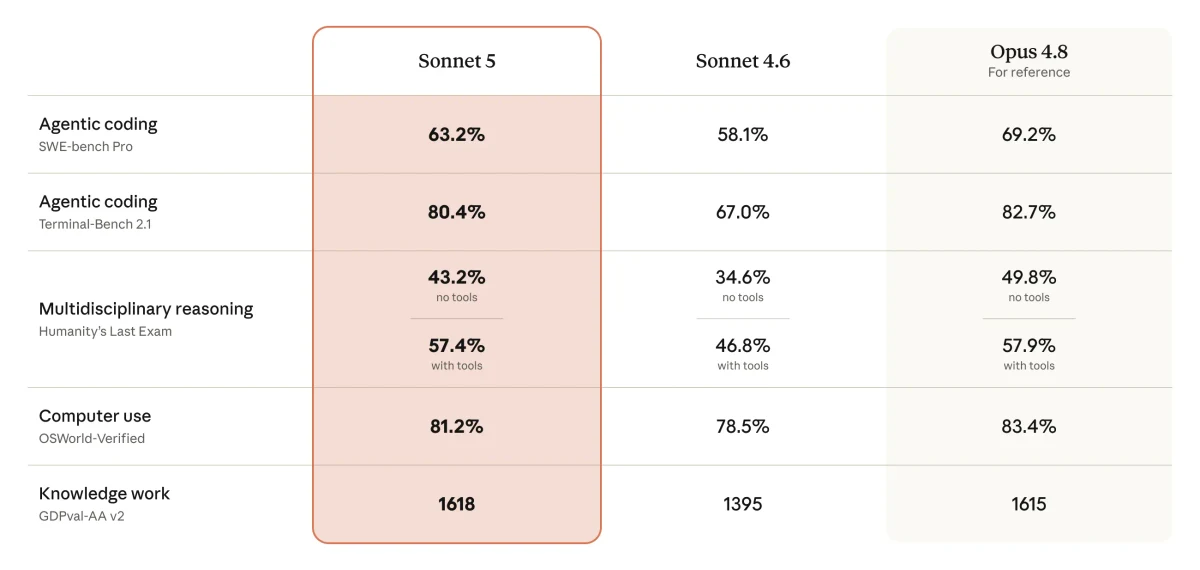
Scores for Sonnet 5 on a variety of evaluations compared to those of Sonnet 4.6 and Opus 4.8 (a more generally capable model, for reference). The Claude Sonnet 5 System Card reports a broader set of evaluations in detail.
For developers, this matters more than benchmark screenshots.
Most engineering work is not solving olympiad math problems. Most engineering work looks more like:
- understanding unfamiliar codebases
- reviewing pull requests
- generating tests
- debugging production issues
- refactoring existing systems
- updating documentation
- migrating old code
A model that is not always identical to a flagship but meaningfully cheaper often wins in practice. The bet with Sonnet 5 is that the gap is now small enough — and the price difference large enough — to matter.
The Industry Is Moving Toward Agentic Coding
One pattern appears everywhere in recent AI releases: agents, not chatbots, not autocomplete.
Models are increasingly expected to:
- create plans
- use tools
- browse documentation
- execute commands
- verify their own output
- recover from mistakes
Anthropic clearly sees this as the future. Early partner feedback on Sonnet 5 points in the same direction: the model finishes complex tasks where previous Sonnet models would stop short, checks its own output without being asked, and does that work at an attractive price.
That also explains why so many developer tools are converging toward similar experiences:
- Cursor Agent
- Claude Code
- OpenAI Codex
- Gemini CLI
- Windsurf
The industry seems to be moving from:
"help me write code"
toward:
"help me complete software engineering tasks."
That is a much bigger shift than autocomplete ever was. If you are already using agent-style workflows in your editor, Cursor Pro is one place where this shift is most visible in daily work.
Cost Matters More Than Most Developers Admit
There is an uncomfortable reality about AI tooling.
Developers love capability. Companies love cost. Eventually cost usually wins.
Sonnet 5 makes that trade-off unusually concrete. According to the launch announcement, at intro API pricing, Sonnet 5 is 60% cheaper per token than Opus 4.8 ($2/$10 vs $5/$25). At standard pricing ($3/$15), that gap narrows to 40% (compared with $5/$25 for Opus 4.8). These numbers can change — for the latest comparison, see Anthropic's official pricing documentation.
Either way, the difference is meaningful for teams running agents that burn tokens on planning, tool calls, retries, and verification loops.
If a model delivers much of the agentic capability teams need at a meaningfully lower per-token cost, many teams will choose the cheaper option — especially when AI usage moves from experimentation to infrastructure.
Once AI becomes part of CI pipelines, code review workflows, internal tooling, and agent systems, token costs suddenly become operational costs. That changes purchasing decisions very quickly.
Anthropic also notes that Sonnet 5 uses an updated tokenizer, so the same input can map to roughly 1.0–1.35× more tokens depending on content type. Intro pricing is partly designed to keep the transition to Sonnet 5 roughly cost-neutral — but once standard pricing applies in full, total cost per task can feel different. In practice, price per token is not the whole story; you still need to watch total token usage.
Claude Sonnet 5 Might Become the Default Model for Many Developers
This is probably my biggest takeaway.
Claude Sonnet 5 does not need to become the smartest model in the world. It only needs to become:
- good enough
- reliable enough
- cheap enough
Anthropic is already signaling that belief in how it ships the model: Sonnet 5 is the default model for Free and Pro plans, available in Claude Code and on the Claude Platform, and accessible via the claude-sonnet-5 API.
Historically, technology markets often reward the product that finds the right balance rather than the absolute best product. Developers rarely buy the fastest SSD. Companies rarely buy the most powerful server. Most teams optimize for value.
AI will probably follow the same pattern.
Does This Mean GPT or Gemini Lose?
Probably not.
The AI market is becoming increasingly specialized. Some models are better at reasoning. Some are better at coding. Some are better at multimodal tasks. Some are better at cost efficiency.
The more interesting question is no longer:
Which model is the smartest?
The more practical question is becoming:
Which model is the smartest for this particular job?
That is a healthier direction for the industry. Sonnet 5 does not replace the need to understand fundamentals, review diffs, or choose the right tool for the task. It just makes one of the most useful categories — agentic coding at scale — easier to afford.
Closing
Claude Sonnet 5 may not end up being the most powerful AI model released this year. But it might become one of the more important releases for developers.
Because software engineering is not only about intelligence. It is also about speed, cost, reliability, workflow integration, and increasingly, agentic execution.
The AI race is slowly moving beyond benchmark leaderboards. For developers, that is probably a good thing. In real projects, the best tool is rarely the one with the highest score. It is usually the one you can afford to use every single day.
Related reading: Gemini vs ChatGPT vs Claude for Coding, Cursor Pro Review: Is It Worth Paying For in 2026?, Why Developers Should Learn Vibe Coding Without Skipping the Fundamentals.
References
- Introducing Claude Sonnet 5 — Official Anthropic announcement covering agentic capabilities, benchmark comparisons with Sonnet 4.6 and Opus 4.8, pricing, and availability.
- Claude pricing — Official Anthropic pricing documentation for model comparisons and current rates.
- Claude Sonnet 5 System Card — Broader safety and capability evaluation details for Sonnet 5.
- Claude Code — Anthropic's agentic coding tool where Sonnet 5 is available for multi-step development workflows.
Comments
No comments yet
Loading comments...